Skip to content
CHAMP logoCHAMPCreating Hope
& Making Progress

CHAMP Youth Leadership Academy

Developing the next generation of leaders, one CHAMP at a time.

At CHAMP, we believe every young person has the potential to become a leader. Leadership isn't determined by popularity, a title, or who's in charge. It's demonstrated through character, compassion, accountability, hard work, and the willingness to make a difference in the lives of others.

Watch the Academy lessons
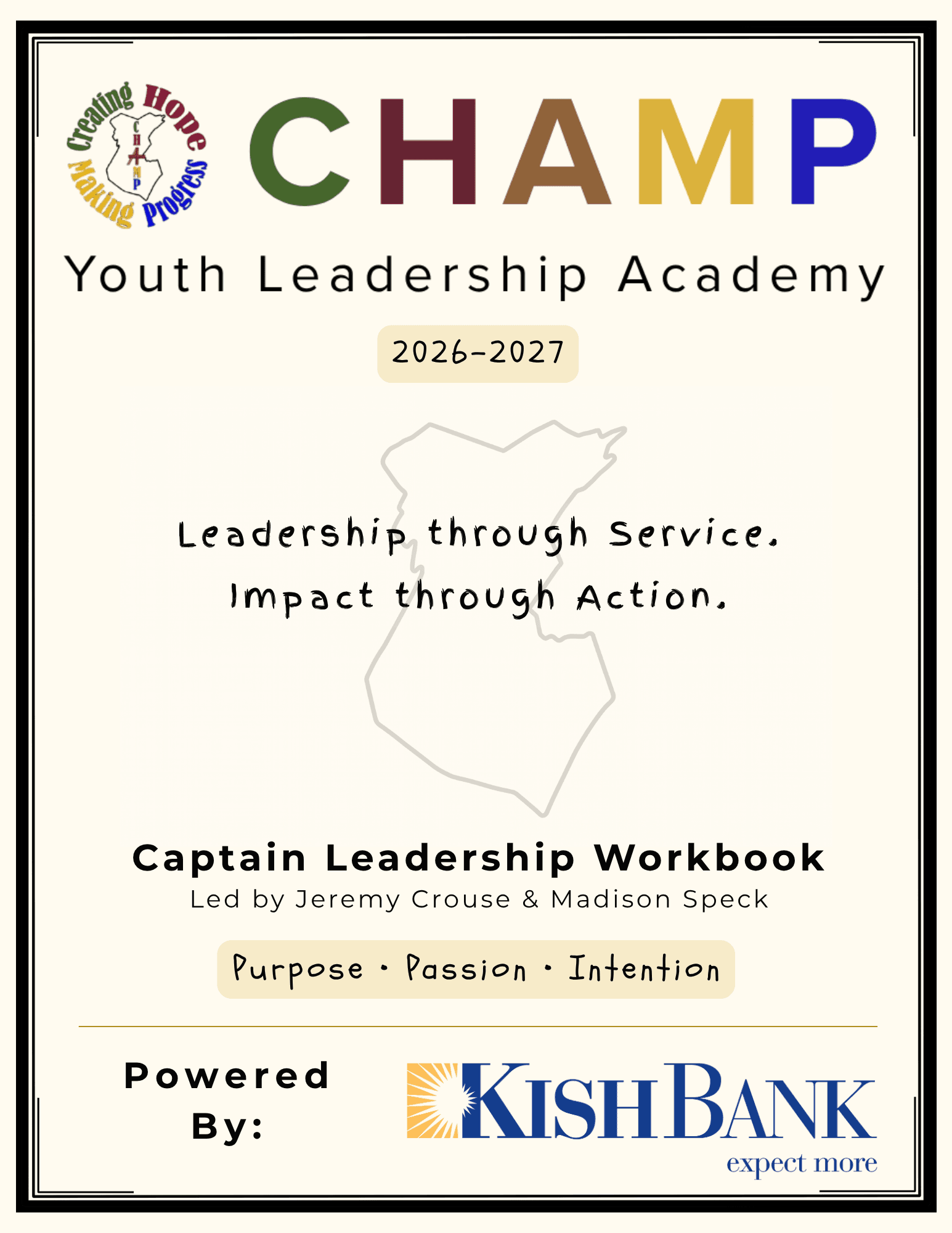
CHAMP Youth Leadership Academy 2026–2027 Captain Leadership Workbook cover, powered by Kish Bank
2026–2027 Captain Leadership Workbook · Purpose, Passion, Intention

Leadership in practice

Skills students can carry into every part of life.

The CHAMP Youth Leadership Academy was created to help young people discover their potential, develop practical leadership skills, and build the confidence to turn their ideas into action.

Building on CHAMP's student-led philanthropic mission, the Academy provides our student captains with opportunities to learn from experienced leaders, explore essential leadership principles, and apply those lessons to real-world situations. Through guided lessons, guest speakers, collaborative discussions, and personal reflection, students develop the skills and mindset to lead with purpose and serve with intention.

Our goal extends beyond preparing students to organize a successful CHAMP event. We want to equip them with the tools to succeed in college, their careers, their relationships, and every leadership opportunity they encounter throughout their lives.

The curriculum is built around 12 essential leadership topics. Each lesson develops a different skill while reinforcing the values that define CHAMP: service, empathy, teamwork, determination, gratitude, and a commitment to something bigger than yourself.

The curriculum

Twelve lessons for a lifetime of leadership.

Each topic builds on the same belief: leadership is a choice we make every day through our actions, decisions, and the way we treat others.

Leadership begins within.

Before you can effectively lead others, you must believe in yourself. This lesson challenges students to recognize their strengths, overcome self-doubt, develop confidence, and pursue their goals even when others question their abilities.

Students explore how fear, negative thinking, and other people's opinions can become obstacles to success. They learn to embrace challenges, accept constructive criticism, and understand that their past does not define their future.

The takeaway: Believe in your potential, take ownership of your future, and never allow someone else's opinion to determine what you believe is possible.
The best leaders serve others first.

True leadership isn't about power, recognition, or personal gain. It's about using your abilities and influence to help others succeed. This lesson introduces students to the principles of servant leadership, emphasizing empathy, humility, integrity, and service over self.

Students learn the importance of listening, supporting their teammates, leading by example, and putting the needs of their mission and community ahead of personal recognition.

The takeaway: Leadership isn't about how many people serve you. It's about how many people you serve and empower.

We accomplish more when we lead together.

No successful leader achieves greatness alone. Shared leadership teaches students how to collaborate, delegate responsibilities, recognize individual strengths, and empower others to contribute meaningfully.

Students explore the importance of trust, teamwork, accountability, and collective decision-making. They learn that effective leaders don't need to control every decision or take every spotlight. Instead, they create an environment where everyone has the opportunity to contribute and succeed.

The takeaway: Strong leaders don't just build successful teams. They build teams capable of succeeding together.

Inspire others through the power of your words.

The ability to communicate effectively is one of the most important skills a leader can develop. This lesson helps students build confidence in public speaking, express their ideas clearly, listen actively, and communicate with different audiences.

Students explore how body language, storytelling, preparation, and authenticity influence the way messages are received. They also learn that communication is a two-way process that requires listening, understanding, and respect.

The takeaway: If you want people to believe in your vision, learn to communicate it with clarity, confidence, and purpose.

Build relationships that create opportunities.

Networking is about more than exchanging names or collecting contacts. It's about developing genuine relationships, learning from others, and building connections based on mutual respect and shared interests.

Students learn how to introduce themselves professionally, ask meaningful questions, follow up with new contacts, and build relationships with mentors, community leaders, business professionals, and peers. They discover how strong relationships can create opportunities and broaden their understanding of the world.

The takeaway: Build relationships before you need them, approach others with curiosity, and always look for ways to provide value in return.

Turn passion for a cause into meaningful impact.

Successful fundraising begins with a mission people can believe in. This lesson teaches students how to establish fundraising goals, develop creative fundraising ideas, engage donors, approach sponsors, and communicate the difference their efforts will make.

Using CHAMP as a real-world example, students explore how teamwork, persistence, community partnerships, and a compelling purpose can bring people together to support families in need.

The takeaway: People are more likely to support a mission when they understand why it matters and believe their contribution will make a difference.

Tell your story. Share your mission. Inspire action.

In today's connected world, how an organization communicates its mission can determine how effectively it reaches and engages its audience. This lesson introduces students to branding, storytelling, content creation, social media strategy, and audience engagement.

Students learn how to develop compelling messages, promote events, create engaging content, and represent their organization responsibly online. They also explore digital citizenship, privacy, professionalism, and the importance of protecting the trust and reputation of the organization they represent.

The takeaway: Use your voice and your platforms to inform, inspire, and bring people together around a purpose.

Your character is revealed by how you handle challenges.

Disagreements are a natural part of teamwork and leadership. What matters is how we respond to them. This lesson helps students develop the emotional awareness and communication skills necessary to navigate conflict constructively.

Students learn to listen to different perspectives, manage emotions, address misunderstandings, give and receive feedback, and work toward solutions that respect others while keeping the team's goals in focus.

The takeaway: You don't have to agree with everyone, but you must learn to disagree respectfully, address problems constructively, and keep moving forward.

Responsible leaders are responsible stewards of resources.

Every successful initiative requires thoughtful planning and responsible financial decisions. This lesson introduces students to budgeting, financial accountability, resource allocation, and the importance of tracking income and expenses.

Through practical examples, students learn how to develop realistic budgets, prioritize spending, anticipate costs, and make informed decisions that support their goals. They also explore why transparency and accountability are essential when managing money entrusted to them by donors and community partners.

The takeaway: Passion may start a project, but responsible financial management helps make it successful and sustainable.

Turn good ideas into completed goals.

Ideas create possibilities, but execution creates results. Project management teaches students how to transform an idea into an organized plan with clear objectives, defined responsibilities, realistic timelines, and measurable outcomes.

Students learn how to break large projects into manageable tasks, establish deadlines, coordinate teammates, monitor progress, anticipate challenges, and adjust when circumstances change.

Through the lens of CHAMP events and fundraisers, they discover how preparation, organization, communication, and accountability help turn ambitious goals into successful outcomes.

The takeaway: Set a clear goal, develop a plan, take action, measure progress, and see the job through to completion.

Build something bigger than yourself.

Organizational leadership focuses on the skills needed to guide a team, establish a positive culture, align people around a common mission, and create systems that support long-term success.

Students explore leadership responsibilities, decision-making, delegation, accountability, organizational values, and the importance of clear expectations. They learn how effective leaders balance immediate priorities with the bigger picture while creating an environment where others can grow and succeed.

They also examine how leadership transitions, documentation, and knowledge-sharing help an organization maintain momentum when individual leaders move on.

The takeaway: Great leaders don't simply achieve results during their time in charge. They leave their organization stronger, more capable, and better prepared for the future.

The ultimate legacy of leadership is developing other leaders.

Leadership doesn't end when your responsibilities are complete. One of the most meaningful things a leader can do is share knowledge, provide encouragement, and help others discover their own potential.

This lesson explores the value of mentorship, learning from experience, accepting feedback, and investing in the growth of others. Students learn how to seek guidance from people they respect while recognizing their own ability to support and encourage those coming behind them.

Within CHAMP, mentorship is especially important as experienced captains pass on their knowledge, traditions, and lessons learned to the next generation of student leaders.

The takeaway: Your legacy isn't just what you accomplish. It's what you teach, the people you empower, and the leaders you help develop.

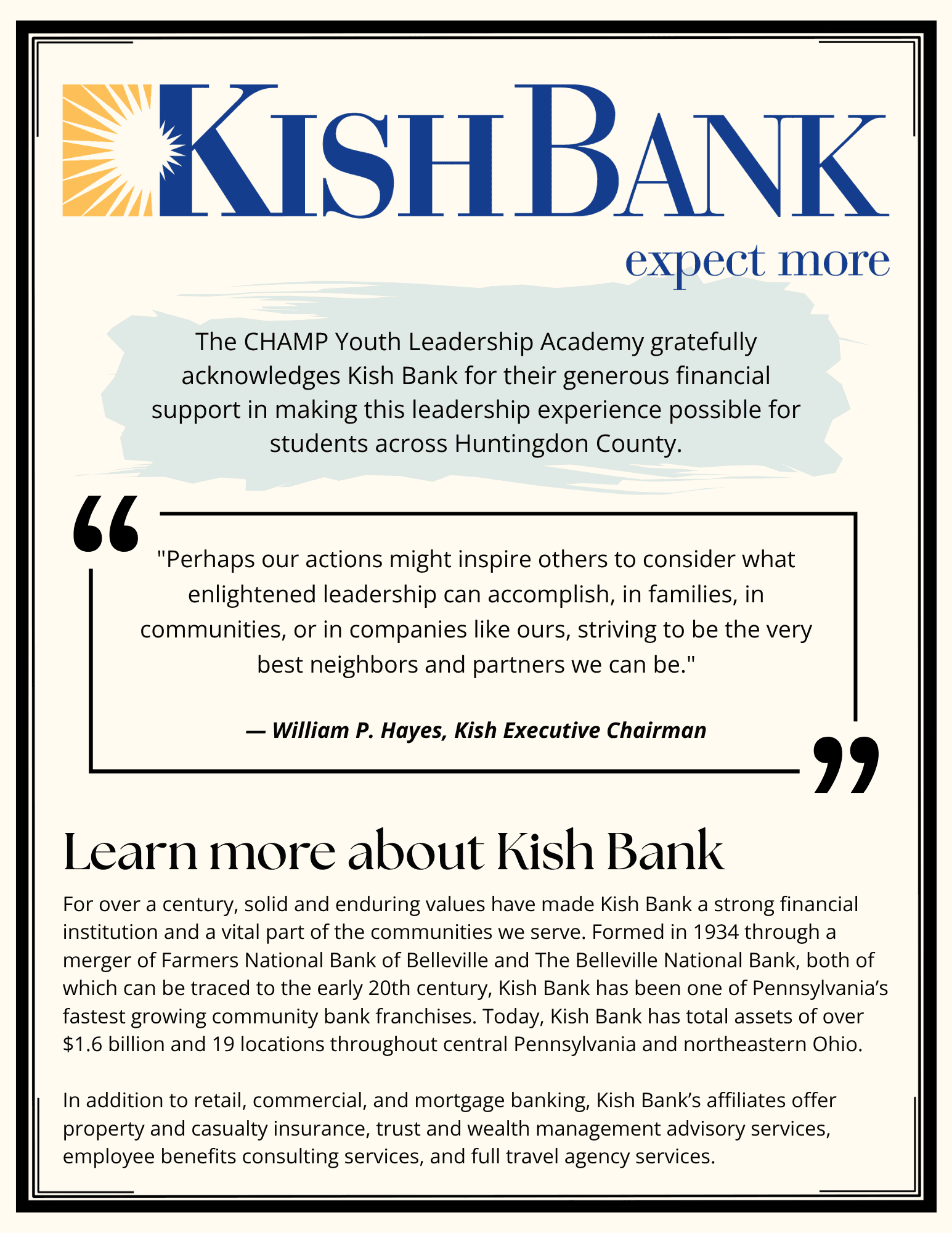
CHAMP Youth Leadership Academy thanks Kish Bank for supporting students across Huntingdon County; the image includes a statement from Kish Executive Chairman William P. Hayes and information about Kish Bank.
Kish Bank is powering the 2026–2027 Academy experience.

With gratitude

Thank you, Kish Bank.

The CHAMP Youth Leadership Academy gratefully acknowledges Kish Bank for its generous financial support in making this leadership experience possible for students across Huntingdon County.

“Perhaps our actions might inspire others to consider what enlightened leadership can accomplish, in families, in communities, or in companies like ours, striving to be the very best neighbors and partners we can be.”

William P. Hayes, Kish Executive Chairman

A commitment to young leaders

The CHAMP Youth Leadership Academy represents our commitment to investing in the young people who will shape the future of our communities.

We want our students to leave the Academy with more than a collection of leadership skills. We want them to develop the confidence to pursue ambitious goals, the humility to learn from others, the courage to face adversity, and the compassion to recognize when someone needs help. We want them to understand that leadership is not reserved for a select few. It is a choice we make every day through our actions, our decisions, and the way we treat others.

Whether our students go on to become business owners, educators, community leaders, entrepreneurs, parents, or simply someone who makes another person's life a little better, the lessons they learn through CHAMP will continue to serve them. Because when we invest in young leaders, we invest in the future of our entire community.

Explore all 12 lessons

BELIEVE IN YOURSELF. LEAD WITH PURPOSE. SERVE OTHERS. MAKE AN IMPACT.

Watch the CHAMP Youth Leadership Academy conversations and lessons on our YouTube channel.

Visit the YouTube channel
Donate